Lightning-struck trees — the county that leads the nation
Polk County recorded 1,057,635 lightning events in 2025, more than any county in America. A lot of them hit trees. Here's what a strike does, how to tell whether the tree will live, and when it has to go.
Why here
Central Florida is the lightning capital of the United States, and Polk County is the center of it: sea breezes from both coasts collide over the peninsula on summer afternoons, thunderstorms build over the Green Swamp and the ridges, and the result in 2025 was 1,057,635 lightning events in the county — the most of any county in the country. Lakeland's storms run June through September, almost daily in July and August. Trees are the tallest things on most lots, and the tall, isolated ones — a lone slash pine in a pasture, a big live oak above a Lake Hollingsworth house — take the strikes.
What a strike does
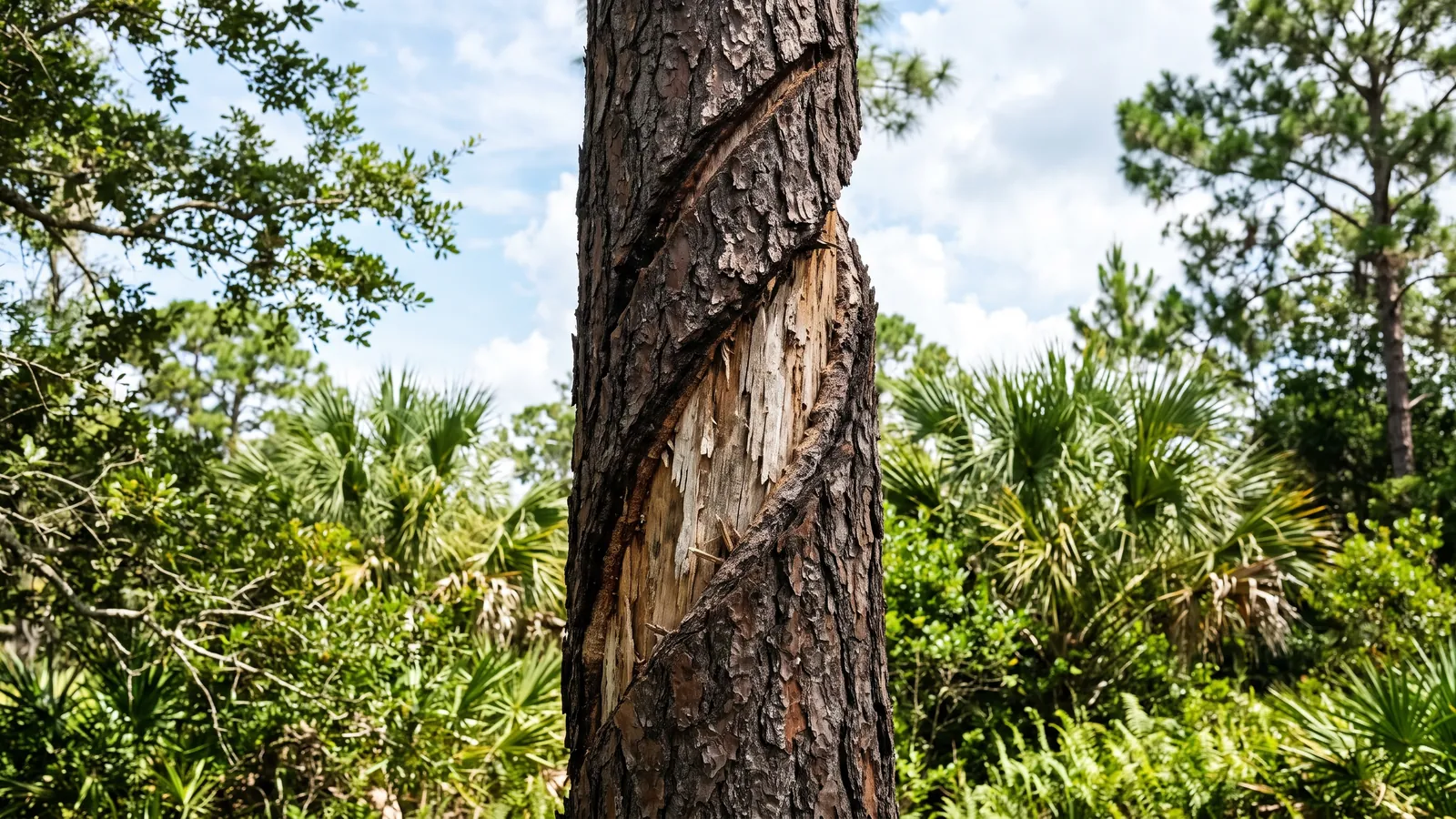
Lightning follows the path of least resistance down the tree, which is the wet layer just under the bark. The current boils the sap, and the steam blows the bark off in a strip — the spiral scar you see running down a trunk is the strike's path. Depending on the tree, the moisture and the strike, the damage runs from nothing visible to the tree exploding. The common outcomes:
- A single narrow scar down one side. The tree often survives, compartmentalizes the wound and carries the scar for life. Live oaks and bald cypress are good at this.
- Bark stripped around most of the trunk. The cambium is girdled; the tree is usually dead within a year even if it leafs out once more.
- Internal damage with little visible. The current ran down the center; the tree looks fine and dies slowly over a season, or stands dead for a year and fails.
- Explosive splitting. The trunk or a major limb splits; the tree is structurally finished regardless of whether it's alive.
- Palms. A struck palm usually dies — the growing point at the top is the first thing hit — and shows it as a collapsed crown within weeks.
The pine problem
A lightning-struck pine is a beetle magnet. The strike stresses the tree and the wound releases the volatiles that Ips engraver beetles home in on; within weeks a struck slash pine can be covered in pitch tubes. If the strike didn't kill the pine, the beetles usually will. So a struck pine gets watched closely for a season — pitch tubes, frass, fading needles — and comes down at the first sign. See the beetle guide.
Wait or remove?
Wait and watch when the damage is a single scar, the tree is a wind-resistant species (live oak, cypress, magnolia), the structure is sound, and the target — what it would hit — is low. Water it through the stress, don't fertilize, and look again in three months and again next spring. Remove when the bark is stripped most of the way around, the trunk or a major limb is split, the tree is a laurel oak or water oak that was marginal anyway, the species is a pine with beetle signs, or the tree stands over a bedroom and you'd rather not find out. Our arborist assesses struck trees and gives you the honest odds.
Protecting a tree you can't replace
For a single irreplaceable tree — the hundred-year live oak that defines the property — a lightning protection system (copper conductors from the top of the tree to a ground rod, installed to the ANSI A300 Part 4 standard) diverts a strike around the living tissue. It costs $1,500 to $4,000 for a big oak and it's the only prevention there is. It's not worth it for most trees; it's worth it for some.
Common questions
The tree was hit two weeks ago and looks fine. Is it OK?
Maybe. Internal damage can take a season to show. Watch for leaf wilt or dieback on one side, cracks opening in the bark, fungus at the base, and on pines, pitch tubes. Have it looked at in three months regardless.
Can a lightning-struck live oak be saved?
Often — a single scar on a healthy live oak is usually survivable. The tree walls off the wound and lives with the scar. What kills live oaks is girdling or splitting, not the scar itself.
Should I fertilize it to help it recover?
No — fertilizer pushes growth the stressed tree can't support. Deep water during dry spells, mulch the root zone, and leave it alone otherwise.
Will insurance cover a tree killed by lightning?
Removing the standing tree, no. If it falls on the house, yes, as a lightning loss. The argument for removing a struck tree that's dying is the same as for any dead tree: it's cheaper standing than on the roof.
Is a lightning rod on a tree real?
Yes — a tree lightning protection system to ANSI A300 Part 4 is a real installation done by arborists. It's for the one tree you can't replace, not the whole yard.
Related: Dead pine removal · Pine bark beetles · Tree removal · Oak care