Tree service for historic Lakeland — the century oaks and the laurel oaks that aren't
Dixieland, Beacon Hill, Lake Hunter Terrace and the Lake Morton districts were planted in the 1910s–30s. The live oaks are the city's treasure. The laurel and water oaks beside them are at the end of their lives.
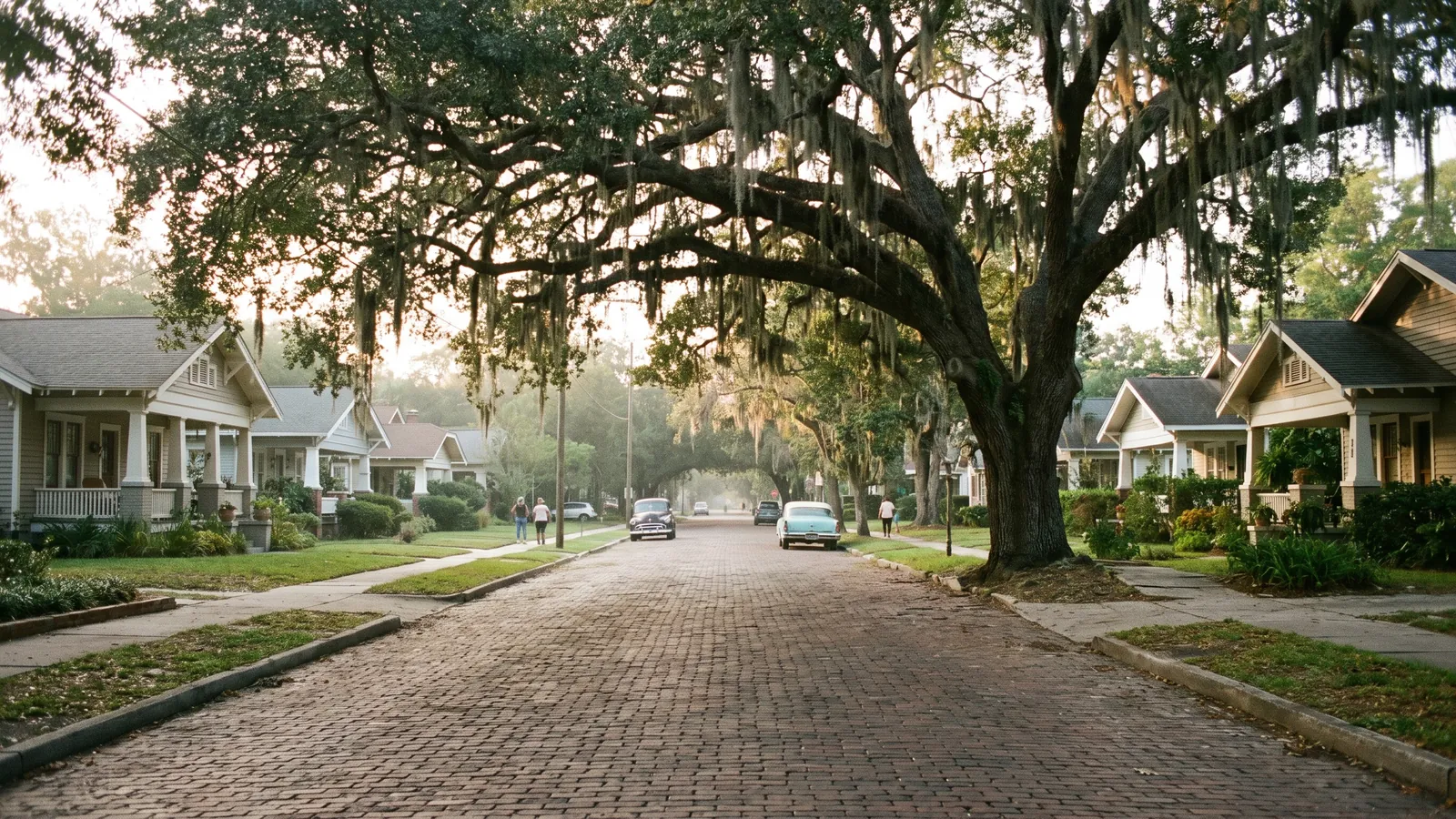
Historic Lakeland is the ring of neighborhoods around Lake Morton, Lake Hollingsworth, Lake Hunter and Lake Mirror: Dixieland, platted in 1907 and on the National Register since 1994 with 556 contributing buildings; Beacon Hill, platted in 1923 with the live oak as its district symbol and 'an expansive tree canopy' written into its historic designation; Lake Hunter Terrace with its mature canopy; the South and East Lake Morton districts of 1906–26 bungalows; Biltmore-Cumberland from 1922; and the Lake Mirror promenade of 1926–28 downtown. The brick streets, the Spanish moss and the swans on Lake Morton — descended from the pair Queen Elizabeth II sent in 1957 — are why people buy here, and the oaks are the canopy over all of it.
The work is delicate and constant. The live oaks need preservation pruning — deadwooding, crown cleaning, weight reduction over the bungalows — on a three-to-five-year cycle, and they need protecting from the root damage that comes with every renovation and driveway. The laurel oaks and water oaks planted beside them a century ago are at 50 to 70 years old and past their lifespan: hollow trunks, decay columns, limbs the size of a car dropping on roofs. Taking one down between two bungalows on a 50-foot lot with a brick street out front is a rigging job done in small pieces over a full day, and we do a lot of them. Lots here are nearly all under an acre and single-family, so the city's tree-preservation permit generally doesn't apply to private trees; the trees between the sidewalk and the brick are the city's, and the City Tree Crew handles those.
What we do in Historic Lakeland
Live oak preservation
Deadwooding, crown cleaning and weight reduction on the century oaks, to ANSI A300, every three to five years.
Laurel & water oak assessment
Species confirmed, trunk sounded, decay probed, and a straight answer about remaining life.
Tight-lot rigging
Removals in small sections over bungalows, porches, fences and brick streets — nothing dropped.
Root-zone protection
Advice for renovations, driveways and utility trenches near the critical root zone.
Storm response
The historic districts lose the most limbs in every storm; we're there the morning after.
Right-of-way coordination
We handle your trees; the strip by the street is the City Tree Crew's (863-834-2233), and we'll say which is which.
Neighborhoods and areas we cover
- Dixieland
- Beacon Hill
- Lake Hunter Terrace
- South Lake Morton Historic District
- East Lake Morton Historic District
- Biltmore-Cumberland
- Lake Mirror & downtown
- Munn Park area
- Lake Hollingsworth north shore (Florida Southern)
- Cleveland Heights
- Lake Bonny
- South Florida Avenue corridor
Tree services available in Historic Lakeland
- Tree removal, 24/7 emergency service, crane removal
- Trimming & pruning, oak care, palm trimming
- Palm removal & lethal bronzing, dead pine removal, stump grinding
- Hurricane prep, storm cleanup, land clearing
Questions from Historic Lakeland homeowners
How do I know if my oak is a live oak or a laurel oak?
Live oak: thick, leathery, dark oval leaves kept all winter; deeply furrowed blocky bark; wide, low spread. Laurel oak: thinner, pointed leaves dropped in spring; smoother gray bark; taller, upright form. Send a photo — the difference decides whether the tree has a century left or a decade.
Can I remove a tree in a historic district?
On a single-family lot under an acre, Lakeland's tree-preservation code doesn't require a permit for a private tree, historic district or not. The historic designation governs buildings, not private trees. Right-of-way trees belong to the city.
How do you get a 60-foot laurel oak out from between two bungalows?
In pieces, on ropes, all day. A climber works the canopy down limb by limb with a ground crew lowering every piece; the trunk comes down in sections. The brick street usually serves as the landing zone with cones out.
Will you damage the brick street?
We put mats under the chipper and the truck and we don't drop wood on the brick. If a crane is needed, outriggers go on pads.
Nearby: North Lakeland · South Lakeland · East Lakeland · Bartow · full service area